Altcoin Watchlists Shrink 19% After Three Red Days in a Row
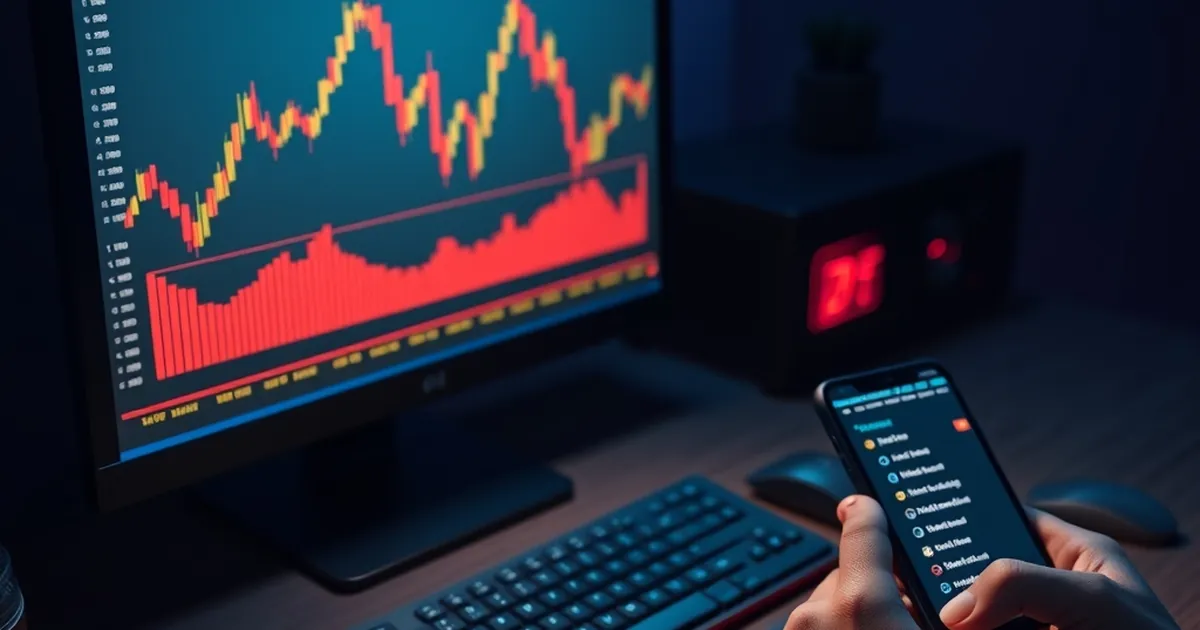
Three consecutive red days and the average altcoin watchlist contracts by 19%. That figure is worth interrogating, because a watchlist is not a portfolio — it is a record of attention, and attention is where most trading decisions actually begin. What does it mean when the coins we stop looking at disappear faster than the positions we hold?
The Watchlist as a Behavioural Instrument
A watchlist sits between intention and action. Adding a token is cheap; removing one is cheaper still. That asymmetry makes it an unusually clean signal of sentiment, stripped of the friction that accompanies actual buying and selling.
There is a useful parallel in Kahneman and Tversky's work on loss aversion: losses register roughly twice as painfully as equivalent gains feel good. A watchlist, though, is not a ledger of losses. It is a ledger of anticipated losses — the coins you were considering but never bought. When three red days arrive in sequence, the pain of watching unrealised ideas decay appears to outweigh the mild optimism that kept them listed.
The 19% contraction is therefore less a story about prices than about the cost of cognitive upkeep. Every watched coin demands periodic attention, and under stress the brain prunes the list to reduce load.
Variable-Ratio Reinforcement and the Cost of Checking
Altcoin markets are structurally prone to one of the most persistent findings in behavioural psychology: variable-ratio reinforcement. B. F. Skinner's operant conditioning research established that rewards delivered on unpredictable schedules produce the most durable and most frequent response patterns — more so than predictable rewards.
Anyone who has refreshed a chart through a quiet weekend knows the shape of this. The problem is that variable-ratio schedules do not merely encourage checking; they make cessation feel risky. Removing a coin from a watchlist creates a small, nagging fear of missing the one move that would have justified the attention.
The 19% figure suggests that after three down days, a meaningful share of watchers decide the fear of missing out is cheaper to bear than the daily cost of looking. That is a rational trade dressed in emotional clothing.
A Concrete Case: The 2022 Rotation
Consider the sequence of failures across late 2022, when a major exchange collapse followed a prolonged drawdown. Public watchlist-tracking data from several portfolio apps showed sharp contractions in tracked asset counts during the worst weeks — contractions that preceded, rather than followed, the largest price declines.
The lesson is that watchlist shrinkage behaves as a leading indicator of engagement, not a lagging one. People stop watching before they stop caring, and the gap between those two states is where liquidity quietly drains.
Decision-Making Under Uncertainty
Altcoin analysis is an exercise in reasoning with thin information. Where Bitcoin offers deep history and broad coverage, most altcoins offer fragmented data, opaque tokenomics and a small pool of informed participants. Under those conditions, watchlists function as a crude Bayesian prior: a curated set of hypotheses worth monitoring.
Three red days do not invalidate the hypotheses. But they do raise the perceived cost of maintaining them, and humans are notoriously poor at separating the quality of a thesis from the discomfort of holding it. Competitive traders — the ones who treat research as a discipline rather than a mood — tend to keep their lists intact through drawdowns precisely because the list is the work.
What to Do With This
If your own watchlist has thinned this week, treat that as data about you rather than about the market. Before the next red streak, set a rule: coins leave the list only when the thesis breaks, not when the price does. Write the reason for each entry down. Then, when sentiment turns, you will still be holding the questions that matter — and you will notice the recovery earlier than the crowd that stopped looking.