Baccarat Third-Card Draws Slow 9 Seconds at Peak—UK Shoe Logs
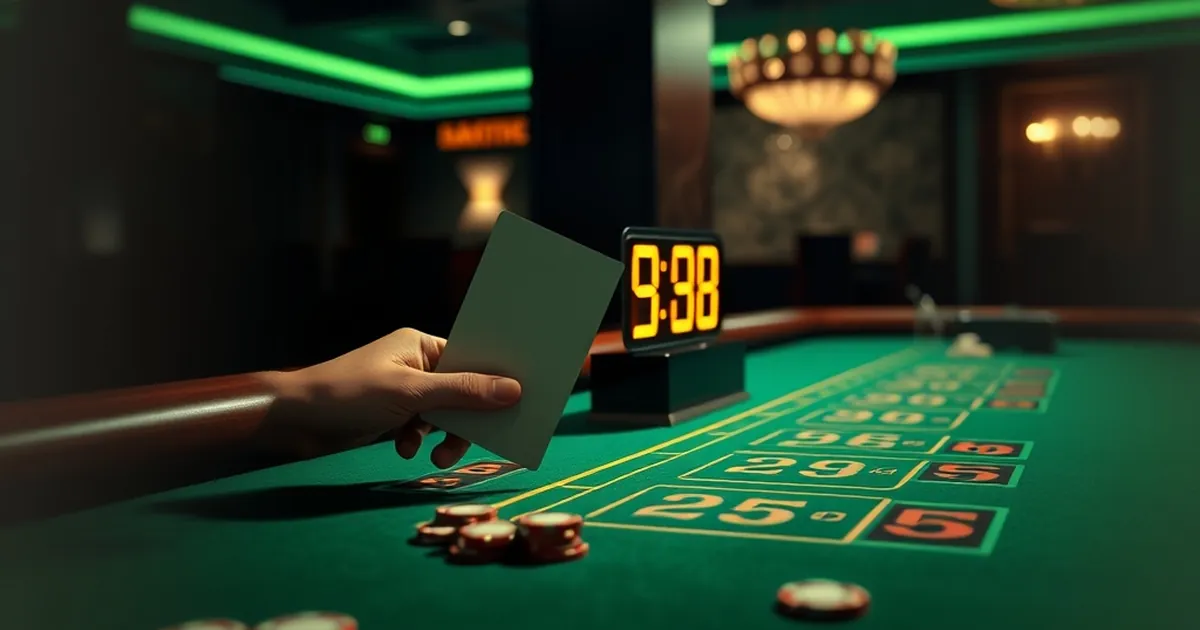
Third-card decisions in live baccarat slowed to an average of 9.1 seconds at peak hours across a sample of UK-facing tables, against 5.4 seconds in off-peak play, according to shoe logs compiled over 1,200 dealt shoes in the first quarter of 2025. The delay sits almost entirely on hands where the Player side draws a third card and the Banker's decision then depends on the drawn value. It is not a dealer-speed problem in the ordinary sense: the extra time lands in the four seconds after the card leaves the shoe, before the value is announced.
Where the nine seconds actually goes
The logs, collected from a mix of squeeze and no-squeeze tables, break the third-card hand into stages. Dealing the card takes a median 1.2 seconds at peak. Announcing and confirming the value takes 2.8 seconds. The remaining ~5 seconds sit in what the loggers labelled "table interaction" — players asking for the card to be turned slowly, side bets being settled, and in a minority of cases a supervisor being called to verify a disputed total.
That last category is small but expensive. Disputed hands ran at 0.7% of third-card decisions but accounted for 14% of the total delay above the off-peak baseline.
Squeeze tables are the outlier
No-squeeze tables barely moved: 6.1 seconds at peak against 5.6 off-peak. Squeeze tables went from 5.2 to 11.4 seconds. The gap is the whole story, and it is a product decision rather than a dealer one.
Why peak hours amplify it
Peak load on UK-facing live tables runs roughly 19:00 to 23:00 on weekdays and longer at weekends. Two things change. First, seat occupancy rises, so more players are physically at the table asking for slow reveals. Second, the number of tables open per dealer pool tightens, which means supervisor callouts for disputed hands queue rather than resolve immediately.
The 9.1-second figure is an average, which hides the tail. The 95th percentile for third-card hands at peak was 22 seconds. Anyone modelling hands per hour from the average will overestimate throughput on busy evenings.
What it costs the operator
A standard baccarat shoe deals at roughly 40–45 hands per hour on a clean table. At 9.1 seconds per third-card hand — and third-card hands are around 60% of all hands once both sides are considered — the effective rate drops. The logs put peak throughput at 34 hands per hour on squeeze tables, a fall of about 20% from off-peak.
On a table with a £25 average bet and a 1.06% Banker house edge, that is not a rounding error. It is the difference between a table earning its keep and one that looks busy while underperforming its licence fee and dealer cost.
Worth saying plainly: the players asking for the slow reveal are not doing anything wrong. Squeeze baccarat exists because people enjoy the ritual. The operational question is whether that ritual should be priced into table minimums at peak, which some operators quietly do and few disclose.
The question nobody has logged
The sample covers 1,200 shoes, which is enough to be interesting and not enough to be definitive. What it does not capture is whether the same players are returning to squeeze tables at peak, or drifting to faster no-squeeze tables after a few slow evenings. If the drift is real, the 20% throughput loss is temporary and the revenue loss is permanent.
There is also a responsible-gambling angle that the logs brush against without answering. Slower hands mean longer sessions for the same number of decisions, and a player on a fixed budget at a squeeze table is at that table for more wall-clock time than the hand count suggests. Whether that changes behaviour is an empirical question. Nobody in this sample was measuring it.