Dealer Changeovers Add 7 Minutes an Hour at £25 Tables
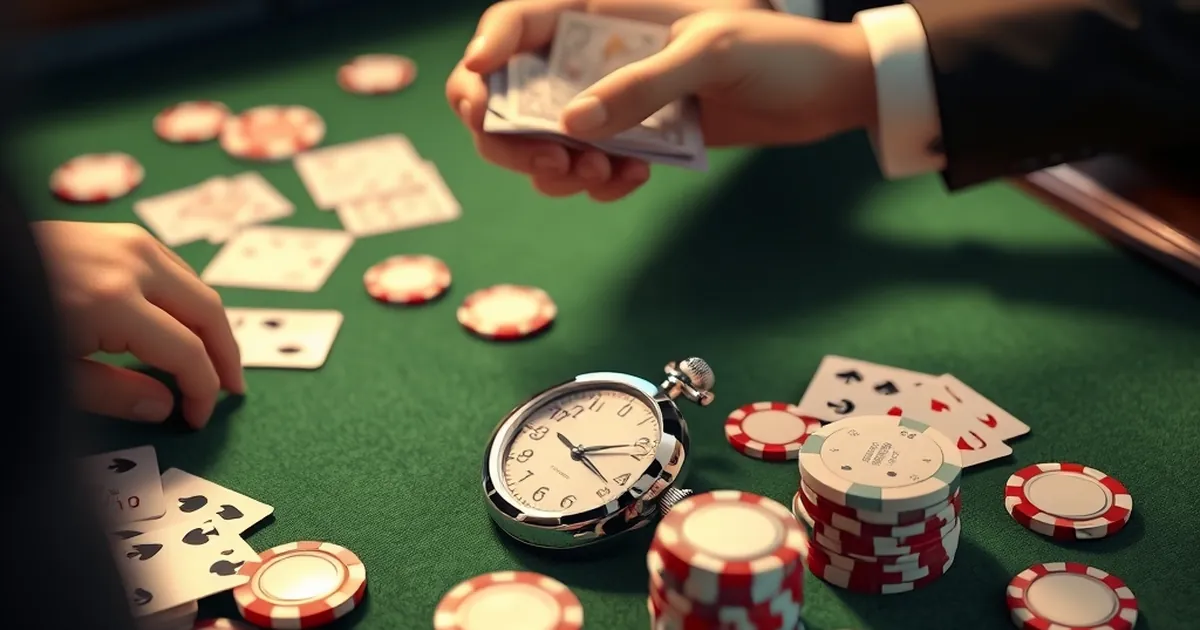
A dealer changeover at a £25 live blackjack table removes the dealer from the felt for roughly 3.5 minutes, and tables typically run two changeovers an hour. That is seven minutes of the 60 in which no cards are dealt — 11.7% of table time — on a game whose house edge is already built into a 0.5% basic-strategy margin. The cost is not the casino's alone: it is paid, in expectation, by whoever is sitting there.
The arithmetic of a dead table
Two changeovers an hour is the common rota on mid-limit live dealer tables, and 3.5 minutes covers the walk-off, the count, the tray swap and the incoming dealer's shuffle and shoe build. Seven minutes is the conservative figure; tables that break a shoe at the same time as a changeover routinely lose closer to nine.
What does that mean per player? A £25 flat bettor getting 60 hands an hour at 0.5% house edge faces an expected loss of £7.50 an hour. At 53 hands, it is £6.63. The saving looks trivial — 87p — until you notice the direction of travel. The player who stays through the dead time is not losing less; they are simply being given fewer chances to win, while the table minimum and any time-based comps keep running.
Where the time actually goes
- Dealer walk-off and incoming dealer sign-in: 45–70 seconds
- Tray count and chip verification: 60–90 seconds
- Shoe build and shuffle to the cut card: 60–90 seconds
- Floor sign-off, if required: 20–40 seconds
The shuffle is unavoidable. The sign-in and the tray count are procedural, and procedures are exactly the sort of thing a card room can compress when it wants to.
Why £25 tables take the hit
Changeovers cluster on tables where the house margin per hand is thin and the labour cost per hour is fixed. A £25 table with four players is generating about £100 of turnover a hand — enough to justify a dealer, not enough to justify a relief dealer standing by. The £100 and £200 tables on the same pit often run a relief rotation that cuts dead time to under two minutes an hour, because the turnover per hand pays for it. The £10 tables can be worse still, but they are also where players expect to wait.
So the seven minutes is a middle-limit tax. It falls on the player who has done the maths on basic strategy, chosen a table with a defensible minimum, and is now watching a chip tray get counted.
What players can actually do
Very little mid-session, and it is worth being honest about that. You cannot speed a count. What you can do is stop treating dead time as neutral. If a session is time-boxed — two hours, say — the seven minutes an hour is 14 minutes of your two hours spent watching nothing. Either extend the session to compensate, or accept that a two-hour booking is really a 106-minute booking.
The other lever is table selection. If a pit has a £25 table running two changeovers an hour and a £50 table running one, the effective cost per hand on the higher minimum can be closer than the headline numbers suggest. Run the expected loss per hour, not per hand, and the cheaper-looking table sometimes isn't.
Casinos, for their part, have an obvious incentive to leave this alone. Dead time costs the operator nothing in expected value — it simply transfers hands out of existence — while the player's time budget drains. That asymmetry is why changeover schedules rarely appear in table signage, and why responsible-gambling tools that track time rather than spend are more useful here than deposit limits. A £50 deposit cap does not notice seven minutes; a session timer does.
The open question is whether live dealer operators will ever publish changeover frequency the way they publish RTP. Slots are regulated on return-to-player percentages over millions of spins; live tables are sold on the fiction of a continuous game. If a 3.5-minute break twice an hour is standard, it is a published specification of the product, not an operational detail — and the player deciding between a £25 table and a £50 one is currently choosing blind.