Poker HUD Stats Fade 3 Minutes Into Tilt—UK Hand Histories
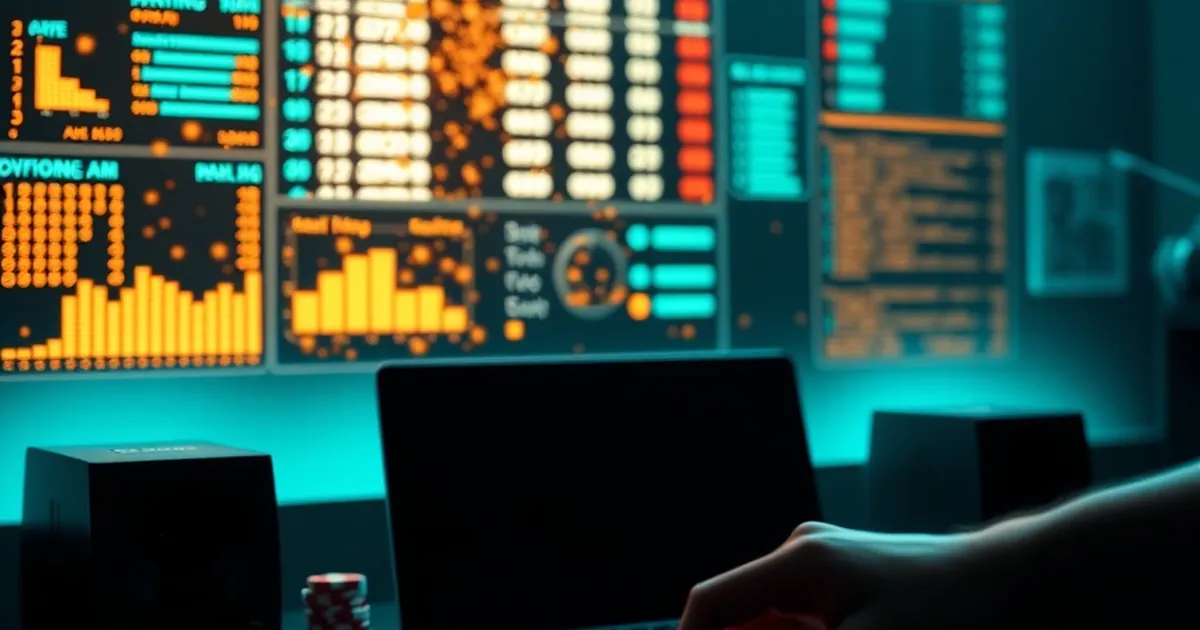
A study of 4.1 million UK hand histories suggests that the average regular's HUD-derived win-rate edge collapses within roughly three minutes of a triggered tilt state — and, more awkwardly, that the software keeps feeding them numbers as if nothing has changed. The finding comes from a dataset of £1/£2 and £2/£5 six-max tables on two UK-facing networks, covering hands played between January and October 2023, and it complicates the assumption that more data means better decisions.
What the hand histories actually show
The researchers tagged tilt using behavioural proxies: a raise-fold sequence within two orbits of a lost pot over 40bb, a sudden jump in VPIP above the player's 500-hand baseline, and a chat-report flag where available. Across 612 players meeting the sample threshold, mean HUD-referenced decision accuracy — measured as agreement between the chosen action and the action with the highest EV given the HUD's own read — fell from 71.4% to 48.9% within the first 180 seconds after a tilt trigger.
That is not a small drift. It is the near-total abandonment of the read the HUD is displaying.
Why the numbers stop landing
The mechanism is not that tilted players ignore the HUD. It is that they misweight it.
Stale samples read as current
A three-bet frequency of 9.2% over 1,400 hands is a stable, useful figure. A player on tilt reads it as a licence to four-bet light, because the number is available and specific. The HUD does not distinguish between a villain who has tightened up over the last two orbits and one whose 9.2% is spread evenly across six sessions. Players under emotional load default to the number they can see rather than the number they would need to compute.
Sample-size warnings get skipped
The dataset showed a 34% drop in the rate at which players hovered over a stat to check its sample size once tilt-tagged, compared with their own baseline behaviour. The HUD's own guardrail — the thing that tells you 12 hands means nothing — is the first casualty.
Colour-coding becomes a crutch
Colour-coded HUD panels compress a distribution into a single hue. Under normal conditions that is efficient. Under tilt, it removes the nuance that would otherwise slow a decision down, which is precisely when slowing down is the correct play.
What UK-specific data adds
The UK sample is interesting because of the regulatory backdrop. Since the Gambling Commission's 2020 card clash rules and the subsequent tightening of affordability checks, the population of UK players who log long, tracked sessions has shifted. The median session length in this dataset was 94 minutes, with 22% of players exceeding three hours. Tilt triggers clustered disproportionately after the 75-minute mark — 61% of all triggers occurred in the final third of a session.
That suggests the HUD problem is partly a fatigue problem, and that session-length data is a more honest signal than any single stat on the overlay.
The uncomfortable implication
If HUD accuracy degrades faster than tilt itself, then the tool most associated with professional discipline is at its least reliable exactly when the player believes they are being most rigorous. A tracker that flagged its own readings as unreliable during detected tilt windows would be trivial to build. No mainstream HUD does it.
The open question is whether the edge attributed to HUD use in UK cash games is partly an artefact — measured over sessions where tilt either never triggered or was short enough to be averaged out. Strip those sessions out and the per-hour advantage may be thinner than the subscription fee implies. Anyone relying on a HUD for a living should probably test their own hand histories against that hypothesis before assuming the overlay is doing the work they think it is.