Why Bitcoin Staking Protocols Are Forcing Validator Tradeoffs
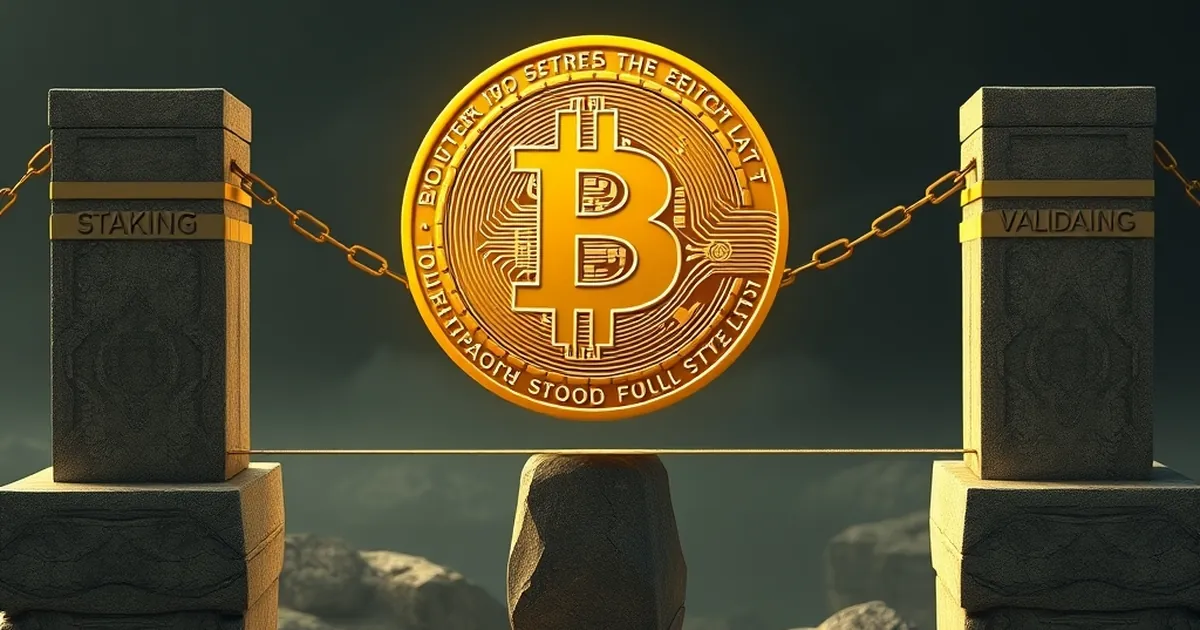
Bitcoin was long considered the digital equivalent of gold: inert, secure, and doing absolutely nothing unless you moved it. That narrative is shattering. New staking protocols are emerging that promise yield on your Bitcoin, but they force validators—and holders—into uncomfortable tradeoffs between security, liquidity, and decentralisation. The real question isn’t whether you can earn yield on Bitcoin, but what you are actually giving up to get it.
The Core Tension: Security vs. Utility
Bitcoin’s security model is famously simple. Miners validate transactions using proof-of-work, and holders secure their own assets via private keys. Introduce staking, and you immediately introduce a third party: a custodian, a bridge, or a smart contract.
These protocols, such as Babylon or Stacks, lock your Bitcoin into a separate layer to earn rewards. The tradeoff is immediate. You are no longer holding native BTC. You hold a representation of it—a tokenised claim—on another chain. If that chain suffers a bug, a governance attack, or a validator collusion, your Bitcoin is at risk. The very property that made Bitcoin resilient—its simplicity—is compromised for the sake of financialisation.
Liquidity Lock-Ups and Opportunity Cost
Most Bitcoin staking protocols require you to lock your coins for a fixed period. During that time, you cannot sell, move, or respond to market events. In the UK, where capital gains tax implications are already complex, locking up an appreciating asset can create real headaches.
You are effectively betting that the staking yield will outperform the potential gains from selling at a market top. That is a speculative bet, not a passive income strategy.
Validator Centralisation: A Growing Risk
Bitcoin staking protocols rely on a set of validators to attest to the state of the staked assets. These validators are not Bitcoin miners. They are often run by the same small group of infrastructure providers who dominate Ethereum staking: Coinbase, Lido, and a handful of institutional staking services.
This centralisation reintroduces a single point of failure that Bitcoin was designed to eliminate. If a majority of validators are compromised or coerced—say, by a regulatory crackdown in the US or EU—your staked Bitcoin could be frozen or confiscated. The tradeoff is clear: yield in exchange for a return to custodial risk.
The Babylon Example
Consider Babylon, a protocol that lets you stake Bitcoin to secure other blockchains. It uses a “self-custodial” model where your BTC never leaves your wallet—in theory. In practice, your Bitcoin is used as collateral in a smart contract on a separate chain. If that chain’s validator set is attacked, your collateral is slashed.
Babylon’s design is clever, but it still relies on an external validator network. You are trusting that network’s security more than Bitcoin’s. That’s a fundamental shift in trust assumptions.
The Liquidity Derivative Trap
Many Bitcoin staking protocols issue a liquid staking token (LST) in return for your staked BTC. You can trade or lend this token, maintaining some flexibility.
But here’s the catch: that LST trades at a discount or premium relative to native BTC, depending on market conditions. During the 2022 crypto winter, some Ethereum LSTs traded at a 5-7% discount. The same will happen with Bitcoin LSTs. You may think you have liquidity, but you actually have a volatile derivative that can lose value even if Bitcoin stays flat.
Practical Takeaway: Don’t Stake What You Can’t Afford to Lose
The most sensible approach for UK-based Bitcoin holders is to treat staking protocols as a high-risk, high-complexity activity—not a default strategy. If you do explore them, only stake a portion of your holdings that you are prepared to lose entirely. Use a hardware wallet, verify the validator set’s reputation, and understand the slashing conditions.
Bitcoin’s strength has always been its simplicity. As the market rushes to financialise it, remember that the best yield may simply be holding the asset itself and waiting. The tradeoffs are real, and they are not for everyone.