Why Crypto Discipline Breaks After 7 Consecutive Green Candles
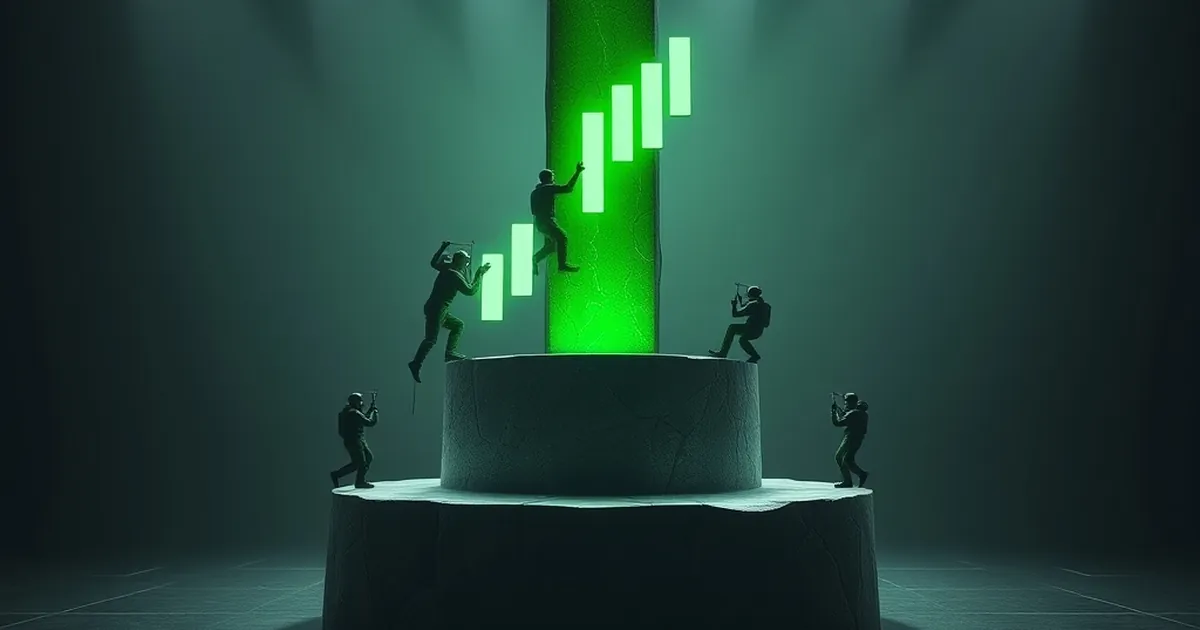
The market has been kind. Seven green candles in a row, your portfolio up a frankly indecent amount, and the quiet confidence that you’ve finally “got it.” Then, without warning, you make a trade that defies every rule you set for yourself — over-leveraging into a pump or abandoning your stop-loss. Why does discipline evaporate precisely when you are winning? The answer lies not in crypto, but in the neurochemistry of reward prediction error.
The Peak-End Rule and the Illusion of Invulnerability
Kahneman and Tversky’s work on hedonic psychology shows we remember experiences by their peak and their end, not the aggregate. After a sustained run, your emotional peak is the last green candle. Your brain anchors to that moment, discarding the statistical reality that mean reversion is a mathematical certainty, not a possibility.
This creates a dangerous cognitive state known as the hot hand fallacy — the belief that past success predicts future success in random or semi-random sequences. In UK trading desks, we call it “chasing the runner.” The discipline you built during bear markets was a response to fear. That fear has now been extinguished by dopamine, and without it, your risk framework has no emotional anchor.
Variable Ratio Reinforcement: The Slot Machine of the Chart
B.F. Skinner’s operant conditioning research identified that variable-ratio schedules — where rewards come after an unpredictable number of responses — produce the most persistent behaviour. A streak of green candles is not a linear progression; it is a variable-ratio schedule in disguise. You do not know if the ninth candle will be green, but the uncertainty itself is the addictive agent.
Here is the uncomfortable parallel: your trading terminal is now operating on the same reinforcement schedule as a fruit machine. The discipline breaks because you are not trading the market; you are trading the anticipation of the next reward. The seventh green candle doesn’t just increase your wealth — it increases your dopamine baseline, making the prospect of sitting out feel like a loss.
Loss Aversion in Reverse: The Fear of Missing Out
Prospect theory tells us losses hurt twice as much as equivalent gains feel good. But after seven green candles, your reference point shifts. You no longer measure against your initial deposit; you measure against yesterday’s high. Missing a potential eighth candle now registers as a loss, even though it is merely an opportunity cost.
This is why discipline breaks with a violent, almost desperate trade. It is not greed — it is loss aversion misapplied to an unrealised gain. A study published in the Journal of Behavioral Finance found that traders who experienced a five-day winning streak increased their position sizes by 40% on the sixth day, despite no change in market volatility. They were not trading the market; they were trading their own recent history.
The Concrete Breaker: Forcing a New Reference Point
You cannot out-discipline a dopamine loop through willpower alone. You must change the structural environment. The practical step is to set a hard rule: after three consecutive green daily candles, your maximum position size is halved. After five, you are cash-only for 48 hours.
This is not a prediction of a reversal. It is a recognition that your decision-making machinery is now calibrated to a reference point that no longer exists. By forcing a pause, you reset your anchor to the present, not the streak. The next time you see seven green candles, treat them not as a signal of strength, but as a warning that your own psychology is about to become the market’s exit liquidity. Plan for that moment now, before the eighth candle decides for you.